Sunday, March 4, 2018

Ever found why travel is such an addiction?

Mala Chandrashekar Sassy SouthIndian


Rumi, the enchanting poet said - 'Travel brings power and love back into your life '

We live in a society that often contemplates us to live every space 'filled' with some sort of a work or a task that we could complete.
In the rush to 'fill and fit' in the tasks we forget to enjoy even the smallest of the moments and times.

Although there's no escaping from these 'fillers', make sure to keep this aside and 
'live-in-the-moment'.. 
enjoy the silence, 
enjoy the echos, 
enjoy the little droplets, 
enjoy the wind as it brushes through you, 
enjoy the cloud play, 
enjoy the gigantic trees to the picturesque hills, 
laugh along as loud, 
sing along, write, read, try local food, 
admire the morning chirps and 
the smell of freshness in the air, 
soak in the sunshine that begins to shine within and 

That's how you make every bit of your travel worthy!

Solo or in a bunch, make the most of your time spent there and let that moment live with you for years to come by .. liven it up and make nostalgia a passe!

Go ahead now..live up to making every travel one of the healthiest of the addictions 😊

Saturday, February 24, 2018

Goddess Kali


godess kali, halebeedu

In her raw form - Goddess Kali, Halebeedu


Goddess Kali - said to be an incarnation of Parvati, wife of the great Hindu God Shiva. She is an embodiment of a strong mother-figure, symbolises the eternal darkness that one fears is both a representation of potential with powers to create and destroy.

Perhaps the most dramatic form in Hindu mythology- Kali is naked, hair unbound, sickle in hand, garland of heads on her neck and a blood stained tongue streching out - a representation that later transformed the outlook of Devi's or Goddess worship in our culture.

Kali also embodies Shakti - the feminine energy, creativity, fertility and became a symbolic representation of ' Maa' (Mother) or 'Maatha' (Mother of all) in the whole of Indian subcontinent.

The sculptures at Halebidu have some of the best examples for hoysala form of architecture- like this one of Goddess Kali, that exudes beautiful intricate sculpting of those times and beliefs.


P.S. Please note that all information are a part of history behind the temple mythology (not mine) and the information may differ based on different perspectives and narratives as the information is a reference from various sources online. I am presenting here my understanding and perspective of the same in a condensed format to keep the blog short and interesting.

You could comment below if you wish to know more in detail about any specific details/ photographs mentioned.

Wednesday, February 14, 2018

The temple between two hills - Achyutaraya, Hampi

achyutaraya temple, hampi

King Achyuta Deva Raya, younger brother and the last of the rulers before the near end of the glorious rule of the Vijayanagara Kingdom – was handpicked by Krishna Deva Raya himself as an able successor.

King Achyutaraya took to throne when the empire was just beginning to face it’s unfavorable times. The opulence and prosperity under Krishnadevaraya were at risk due to internal disagreements and fights for the throne from contenders like Aliya Rama Raya and also the constant infiltration efforts and feudatories who were waiting for an opportunity to bring down the empire.

However, after the succession to the throne in 1529, he built this stellar creation between the Gandhamadana and Matanga hills dedicated to Lord Tiruvengalanatha, a temple which became popularly known by his name as Achyutaraya Temple.

achyutaraya temple ruins of hampi vijayanagara temple india


Reaching the temple structure


Although the structure is a prominent part of the Hampi temple complex – the temple seems to be ‘off-track’ or ‘hidden’ and serves as a quiet abode for those who wish to spend some peace time beyond the touristy areas.

This intricate and alluring temple complex can be reached in two ways - You could take a side trip from the Kodanda Rama Temple (Riverside Ruins path) that takes you to the main temple entrance.

hampi ruins world heritage center India mala chandrashekar karnataka


hampi ruins world heritage center India mala chandrashekar karnataka

Or, If you prefer to walk towards the Nandi – an alternate ascend through the steps after the Bazaar street – that treats you with a magnanimous aerial view of the temple from the hilltop.

achyutaraya temple ruins of hampi vijayanagara temple india

aerial view of temple of hampi indian temple


The Temple Complex


Dwaram


the ruins of hampi world heritage centre incredible india

the ruins of hampi world heritage centre incredible india


A 'Dwara' or entrance in Hindu culture, represents a progressive succession through spaces. The concept of decorative art or intricate designs on the dwara represents an auspicious welcome and removal of negative barriers through the designs.


monochrome image of the ruins of hampi world heritage centre incredible india

The intricate design on the entrance are a representation of the grandeur and the prosperity and the main sanctum is at the centre of two rectangular courtyards.

The main shrine is adorned by Yali’s Also known as the - Indian dragon form.These dramatic and beautiful giant lion like forms are seen in a fighting posture. I found these sculptures awe-inspiring- Here's what I found out about them during my travel.


yali vyala vidala hampi lion elephant and horse


Yali / Vyala or Vidala ( in Sanskrit) is a mythical creature most often sculpted onto the pillars of Hindu temples. It may be portrayed as part lion, part elephant and part horse, and in similar forms and shapes .The reasoning behind these sculptures on the pillars are a representation of life itself. Life is far from being perfect - there are demonic, negative forces always at play in this universe and true art, especially religious Hindu temple art was a true representation of fighting imperfections.

As one enters the inner sanctum, where the deity was supposedly placed - we come across the ‘Dwarapalakas’ or ‘deity guards’. There are multiple theories on Jaya-Vijaya  the two sentinels whose job are to stand at the entrance and keep watch while the Lord rests inside – And as per mythology – I learnt that, one gets the permission mentally from Dwarapalakas, before entering the temple with only to fulfill wishes if they have complete faith in the Lord.

dwarapalaka achyutaraya temple hampi temple vijayanagara kingdom

On the main shrine,on closer look – one gets to see the references of Ramayana and Mahabharata episodes portrayal etched beautifully on the rock pillars of the temple.

ramayana depiction in hindu temples hampi

The above image is a representation of the Ramayana episode : The top part of the pillar has carvings where, Lord Hanuman (never ending tail) is sent to make peace with Ravana and the duo are in conversation.

There is also a carving which shows Sitadevi and Hanuman who gives her the precious jewel of ‘chintamani’ as a representation of Rama’s messenger and a vow to release her from the captivity of Ravana.

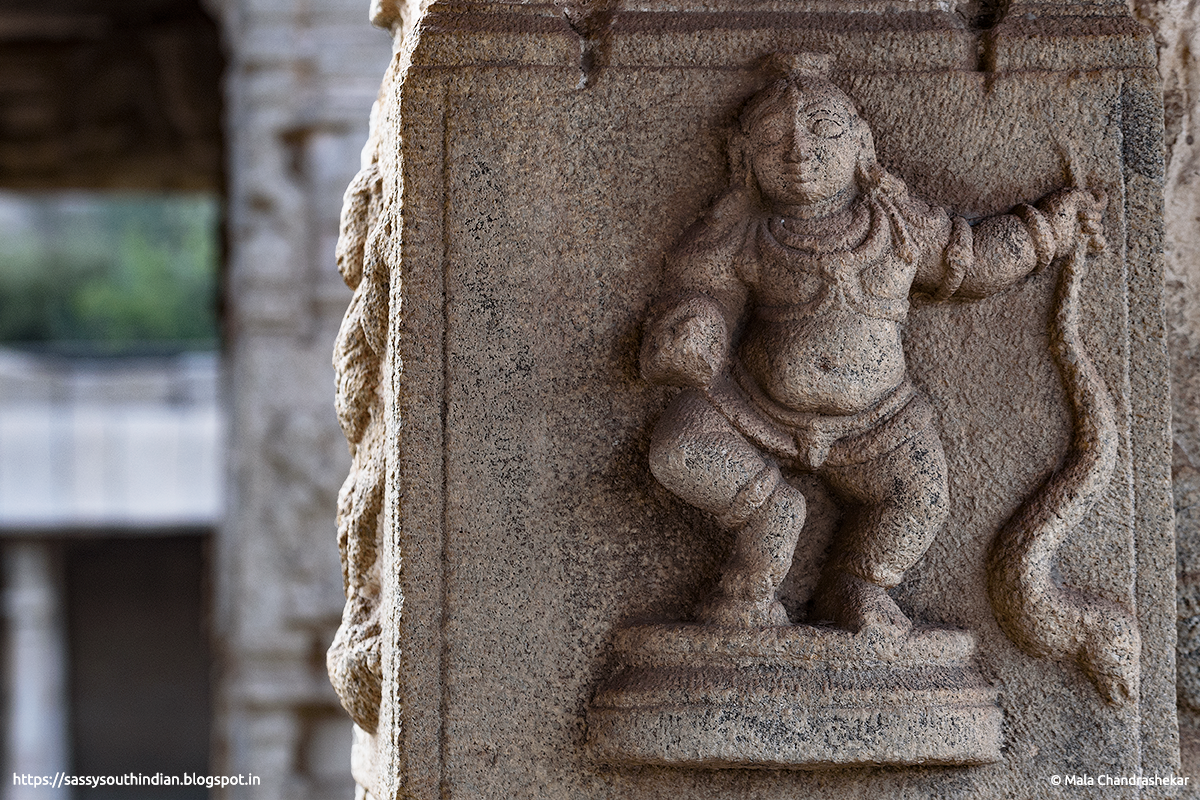
Apart from these scenes – there are some alluring depictions of ‘Muddu Krishna’ (Krishna as a baby) playfully handling a snake.

kalinga mardhana lord krishna sculpture of hampi

And also another image showcasing Krishna in a ‘tribhangi’ posture – I have personally seen some well-known dancers potray this movement in the most delightful sensuous way.

The tribhangi is essentially a three bends in the body - the neck, waist and knee, making one seem  to form a gentle "S" shape making it one of most alluring and graceful positions in dance forms potrayed in representation of Krishna. 

monuments incredible india hampi images karnataka

There are more stupendous sculptures like the court dancer and a Jester showing off some of his antics.

sculptures of india temples incredible india monuments Hampi karnataka tourism

sculptures of indian temples incredible india india tourism karnataka tourism hampi temples

I could fill up more web screens with the fluidity and wonderous sculptures the Achyutara temple complex has -The grandeur and the intricate art of this temple structure gives you a sense of reminiscing the  glorious times before the fall of the Vijayanagara empire and affluence of the kings who were mighty interested in giving art and culture its due even at the very impending end of prosperity.

Let’s set out on a new photographic exploratory temple in my next blog.. More to come!

Have you visited this place? Do share your thoughts!


P.S. Please note that all information are a part of history behind the temple mythology (not mine) and the information may differ based on different perspectives and narratives as the information is a reference from various sources online. I am presenting here my understanding and perspective of the same in a condensed format to keep the blog short and interesting.

You could comment below if you wish to know more in detail about any specific details/ photographs mentioned.


Monday, January 15, 2018

A Marvel called Angkor

‘Art and architecture are like creative discoveries, they speak for themselves’


At the heart of all megalith structures, lies a true and beautiful meaning behind its existence and purpose. Angkor Wat is one such architectural marvel that leaves you spell bound not just for its size but for some of the rarest representation of life a mere 1000 years ago. 

Built by King Suryavarman II in the 12th century as a vast funerary temple that would hold his remains, symbolically confirming his permanent identity with Lord Vishnu – and has sculpted walls that speaks in volumes about the two incarnations of Lord Vishnu as per the Indian Mythology.


The huge structure of Angkor Wat is the best representation of classical style of Khmer architecture and ebbs an aura of divinity that can be found in religious holy shrines. 


Although, it’s a challenge to find pathways at Angkor empty, one gets to see the beauty of the never ending long structure through these mega passages. The temple of angkorwat has series of arched inner temple hallways like these throughout the temple's various levels. The stone on the sidewalls are completely covered with beautiful carvings - depicting the ancient workforms of the Mahabharatha and the Ramayana era.


The many theories of why Angkor was built?

There is not one but multiple theories as to why this megalith temple construction was considered. Let’s try and get some light onto this,as per some experts across the world - both the layout of the Angkor temples and the iconographic nature of much its sculpture, particularly the asuras ('demons') and devas ('deities') sculpted intricately on the walls of the temples are also intended to indicate the celestial phenomenon of the precession of the equinoxes and the slow transition from one astrological age to another.


Conventional theories presume the lands where Angkor stands were chosen as a settlement site because of their strategic military position and agricultural potential. Alternative scholars, however, believe the geographical location of the Angkor complex and the arrangement of its temples was based on a planet-spanning sacred geography from archaic times as per scaredsites. Using computer simulations, it has been shown that the ground plan of the Angkor complex – the terrestrial placement of its principal temples - mirrors the stars in the constellation of Draco at the time of spring equinox in 10,500 BC. While the date of this astronomical alignment is far earlier than any known construction at Angkor, it appears that its purpose was to architecturally mirror the heavens in order to assist in the harmonization of the earth and the stars.


Manifold uniqueness of Angkor 

As early as 12th century the current monument was standing on what was then known as ‘Yasodharapura’ and unlike any other temples in the same area facing east – Angkor specifically is aligned to the west, giving a spectacular sunset view ! The temple complex is a representation of classical style of Khmer architecture with five central shrines , having three levels constructed at various dimensions with moats and gigantic compounds surrounding the built city complex. The western exterior or the extended compound area has forecourts of the main temple contains two libraries or smaller temple structures, which also served as ‘astronomical observatories’.

The Khmer's, adhered to the Indian belief that a temple must be built according to a mathematical system in order for it to function in harmony with the universe. Distances between certain architectural elements of the temple reflect numbers related to Indian mythology and cosmology.


Orthodox archaeologists sometimes interpret the temples of the Angkor complex as tombs of megalomaniacal kings - yet in reality those kings designed and constructed the temples as a form of service to both god and their own subjects as per a few sacred sites. The temples were places not for the worship of the kings but rather for the worship of god. The sacred sanctum, is housed nearly in the middle of the last level of the temple complex and one can be enter this area only at scheduled times and in appropriate dressing as directed by the guards. A steep climb and you can see the spectacular view of the levels below. It houses large figurines mostly disfigured and some restored (possibly the main deity of those times).


The main sanctum is precisely aligned with the stars, constructed as a vast three dimensional yantras and adorned with stunningly beautiful religious art, the Angkor temples were instruments for assisting humans in their realization of the divine.


The site receives more than 2 million visitors annually during peak seasons –for Angkor Wat is a sight to behold. 

Wait for my equally intriguing photo stories on Angkor Thom, the Bayon Temple complexes as well..!


Have you visited this place? Share your experience !


P.S. Please note that all information are a part of history behind the temple mythology (not mine) and the information may differ based on different perspectives and narratives as the information is a reference from various sources online. I am presenting here my understanding and perspective of the same in a condensed format to keep the blog short and interesting 


You could comment below if you wish to know more in detail about any specific details/ photographs mentioned.

Tuesday, January 9, 2018

Hazara Rama (HAMPI) : An intricate temple shrine of Lord Shri Rama

hazara rama temple hampi sassy south indian mala chandrashekar

The magnificent Hampi needs no introduction for its alluring monumental beauty and the legend of the Vijayanagara kingdom behind each temple complex dating back to centuries.

In the many trips to Hampi and having spent days exploring these temple complexes - I have come to understand that there is so much more to this beguiling beauty – where one can get swayed in learning more about the ancient times of kings, the culture, the art, the intellect and their ruling that had the entire empire graciously give them a demi-god status for their benevolence and love for people.

In this blog – I will try and write about the little details of one such wondrous temple complex called Hazara Rama.


Literally translating to ‘a thousand Rama’ and refers to stories carved out on the long arrays depicts the reigning deity of the temple – Shri Rama. The name depicts the then rulers ‘secular’ state of mind and inclusiveness of the then rulers.

The small yet intricately decorated is centrally located and is considered to be a private temple for the kings of Vijayanagara empire.


For someone who is interested in history, I find our epics and mythology truly captivating and the Hazare Raama temple complex truly encapsulates the life, experiences, learnings and journey of Lord Rama and his followers in its true beauty with symbolic representations through the sculptures at the complex.

One needs an eye for detail (a tad bit of patience too 😊) to go around the temple complex and searching for hints to put the dots together.


The Dwara / the entrance are surrounded by captivating sculptures and decorative figurines which were handcarved by sculptors representing the life and legacy of Lord Shri Rama.

As I take you along the temple – I will try and explain a few main stories from the Hindu Epic Ramayana, which are intricately showcased all across Hazaare Raama temple complex.


This part of Ramayana starts with the premise where Sage Vishwamitra who foresees the fate of Shri Rama, the incarnation of Vishnu and to is bestowed to take upon himself the duty to lead the young prince Rama to fulfil his legacy.

There is King Dasaratha, who has angered Sage Vishwamithra and is left with no option but to let go of his beloved sons Shri Rama and Lakshmana to pacify the sage. The sage is overwhelmed by the brother’s humbleness and gladly accepts Shri Rama and Lakshmana as his students – to whom he teaches various skills sets and gives them directions to ensue Ramayana.


hazara rama temple hampi


Thataki Samhara – The Demoness

Once a beautiful princess - who was said to be wooed by and married Sunda, an Asura/demonic King. She finds herself wrecking havoc when sage Agastya curses her husband to death. She is further cursed for her deeds along with her two sons (Maricha and Subahu), which transforms both mother and sons into hideous demonic creatures.

Thataki with the loss of her beautiful physique turns cruel and cannibalistic with her sons and begins to terrorize people, devouring anyone especially the sages who dared to set foot in a forest near River Ganga.

When Sage Vishwamitra wants to end the terror, Shri Rama hesitates but, after advise from his master that as a prince, he had to carry out his duty regardless of his own personal reservations.


Swayamvara

The above image is a representation of Rama and Sita’s swayamvara at Janakapuri . With many characters like Rama, Lakshmana, Sage Vishwamitra and Parashurama in play. The story in summary is about the groom-choosing event for Sita.

The King Janaka, had arranged the swayamwara for the kings of various lands who could win over his daughter – Sita’s hand if anyone of them could break the mighty bow of Shiva – The Shivadhanassu.

After many fail, at the will of sage Vishwamitra, Shri Rama goes towards the Shivadhanassu and lifts it up with great ease. He draws the bow string and the bow breaks into two - The heavens resound with the loud crackle like the skies hit by powerful thunder and lightning. Parashurama touched by the humble polite stance of Rama –after he breaks his own bow, calls him the Vishnu incarnate – God of the universe. Thus the silent wish of Sita came to reality when she garlands the ever enchanting Shri Rama.

hazara rama temple hampi


Battle of the mighty

According to Valmiki Ramaayana , there was a long drawn fight between the Rama’s and the Ravana’s army. There are many opinions on what encompassed through the battle between Indrajit and Lakshmana and this is one such mythical representation.

As per the imagery – When Indrajit (eldest son of Ravana) enters to fight in the battle field – he sees that the opposition army will not be easy to be taken down and decides to use his field of expertise –‘magic and tantra’ to fight against the enemy.

Although, he is the only warrior to have possessed the three ultimate weapons of Trimurti i.e. Brahmanda astra, Vaishnavastra, and Pashupatastra. He was initially able to hit Lakshmana by his special weapon named Shakti – that nearly kills Lakshmana if not for Lord Hanuman who travels to the Himalayas to get the medicinal hillock of Sanjeevani and saves Lakshmana.


The Dasara festivity or the celebration of good-over-evil ‘NAVARATRI’ are brilliantly portrayed on the relics that depict -  processions of horses, elephants, attendants, soldiers and dancing women taking part in the dasara procession back in the century . It is said, the relics are among the most extensive ones to be found anywhere in India.

Although Hazara Rama is one of the main shrines and an important temple complex,it has seized of all its religious activities yet remains one the most visited temples – especially during the dasara and ramanavami times.


hazara rama temple hampi mala chanddrashekar sassy southindian

If you are visiting Hampi – this complex is a must visit and be lost in old world charm!


Have you visited this place? Do comment your thoughts!


P.S. Please note that all stories are a part of our legendary epic mythology (not mine) and the stories may differ based on different perspectives and narratives. I am presenting here my understanding and perspective of the same in a condensed format to keep the blog short and interesting.
You could comment below if you wish to know more in detail about any specific mythical portion of the story/ photographs mentioned.